Welcome Email Sequence Template: 7 Emails With Examples

Anthony Nebel · updated · 21 min read
In short
A welcome email sequence is a series of emails, sent a few days apart, that builds a relationship with new subscribers. Deliver the freebie and introduce yourself first, then send a quick win, your story and more value before any pitch. Three to five emails is a good start.
Key takeaways
- Give people a real reason to sign up, like a discount, free shipping, a guide or a cheat sheet.
- Email 1: greet them by name, deliver the freebie, say who you are and what to expect, and tease the next email.
- After email one, send a quick win, your background story and more value before you pitch anything.
- Ask new subscribers to whitelist you so you stay out of spam, and invite replies to learn what they want.
- Space emails two to four days apart, and test subject lines and copy to see what gets opened.
On this page
- But What Exactly Is A Welcome Email Series?
- Here’s What We Will Cover:
- So How Exactly Do We Increase The Opt-in Rate So People See Our First Welcome Email?
- Here Is A Welcome Email Series Template You Can Use Immediately
- Here is what you should accomplish in your first welcome email:
- Email 1 Example
- Email 2: Give Them Some Valuable Content
- Email 3: Give Your Background Story
- Email 4: Give Them Even More Value
- Email 5: Give Them Even More Value + (Optional: Preview Sale)
- Email 6: Selling Your Product Or Service (Optional)
- Email 7 Follow Up + Example (Optional)
- Now How Do I Set This Up?
- Frequently Asked Questions
- What Should I Do Now?
I have to say your welcome email is probably one of the most important emails to write, mainly because it is the customer’s first impression of you.
Learning how to craft a welcome email sequence template isn’t hard, but there are tips and techniques to improve your customer experience and sales.
But What Exactly Is A Welcome Email Series?
A Welcome Email Series is an email sequence where you send out multiple welcome emails separated by a time interval where each one builds upon another to build a relationship with your customers.
Here Is What A Welcome Email Series Template Can Do For You:
- Create an amazing first impression of your business.
- Help build a relationship with your customer.
- Build brand loyalty
- Build trust and bonds
- Helps establish your authority.
- Solve a specific problem in your customer’s life…
- And people remember you
That is why it is incredibly vital to have a strategy so that subscribers will “go along the journey” and build a connection.
But not everybody who visits your site automatically subscribes. So you first need to give them an incentive.
But before we get into that…
Here’s What We Will Cover:
- How To Increase Your Email Opt-in Rate
- How To Craft The Ultimate First Welcome Email
- Guidelines On How To Create Your Welcome Email Series Specifically For Your Business
- Frequently Asked Questions
- And what you should do after learning all of this information…
So How Exactly Do We Increase The Opt-in Rate So People See Our First Welcome Email?
Let’s give you a quick tutorial on landing page design with some quick dirty tips to help you boost those opt-in rates.
Give them an Incentive
Humans by nature love free things. So in order to get their email address, you need to give them something they want.
For example, if you are an eCommerce store, give them a 10% discount or do something different like offer free shipping forever.
If you are a blogging website, give them a valuable guide on “How to…”
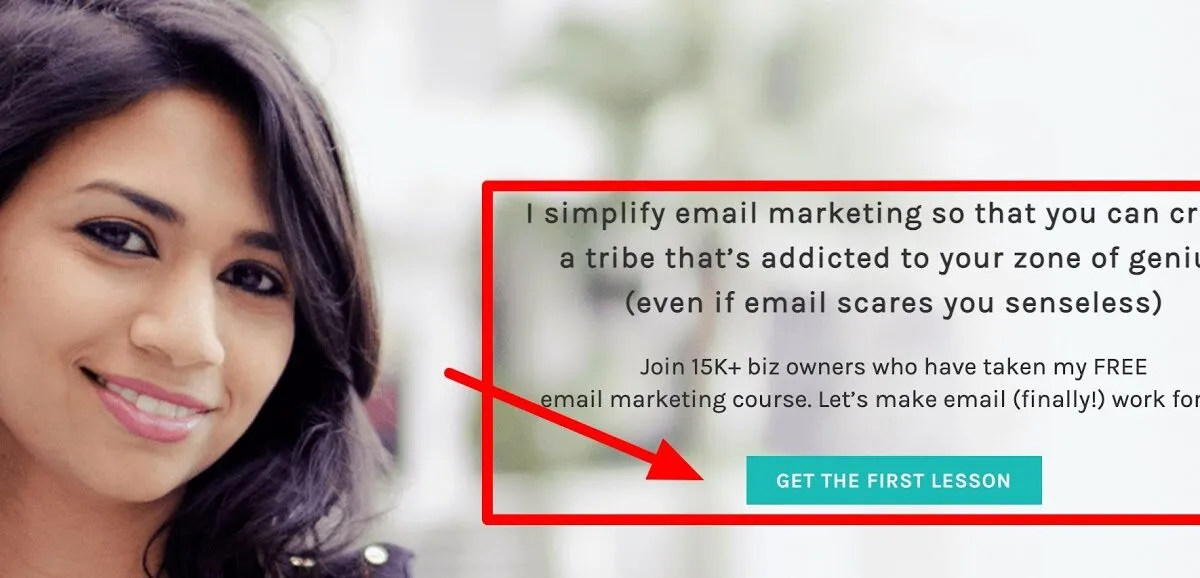
Meera Kothand does a great job with it below…
Here are some more ideas to help jog around your creative brain juice:
- A Free (and valuable) eBook
- A Free Strategy Session
- A Discount (20% Off)
- Exclusive Information
- 30-Day Free Trial (60 if you want to distinguish yourselves from other competitors)
- A Free Photography Session
- Some Community Support
- Free Training
- A Cheat Sheet
- A Template
- etc…
Get creative.
You want to give them something VALUABLE and unique because they are giving you access for you to contact them!
These are possible future customers who might be interested in what you offer!
Add A Way To Opt-In Email On The Side Or At The Bottom Of Your Article
Not only are we selfish, but people are also lazy. This means they will only come on your website for that specific article and head out.
So I advise you to put your opt-in email article on every page but never on the very top because readers don’t know if your free eBook is worth any value until they realize you provide awesome content through your article!
There are some exceptions to this, like if you create an exclusive landing page for your newsletter where people can sign up… (and then sell them through a sales email…)
Or if you are well known already in your community and know that the content you offer will already be valuable.
That’s why to increase your opt-in rate your article needs to be amazing with valuable and useful content. It has to be SOOO good that they won’t ever need any other article for that specific subject.
You basically need to prove your worth.
So if they see your article is actually amazing, then they might check out another article. And another.
Until at one point the reader says, “maybe the free eBook they are offering is pretty awesome…” And maybe they might hit that subscribe button.
Your Call To Action On Your Email Newsletter
You can actually edit the text inside the boxes where you enter your first name and email address. And that’s the only information you really need.
You also want your call to action to have a specific text instead of the usual “enter.”
Here’s a good example of what it should look like:
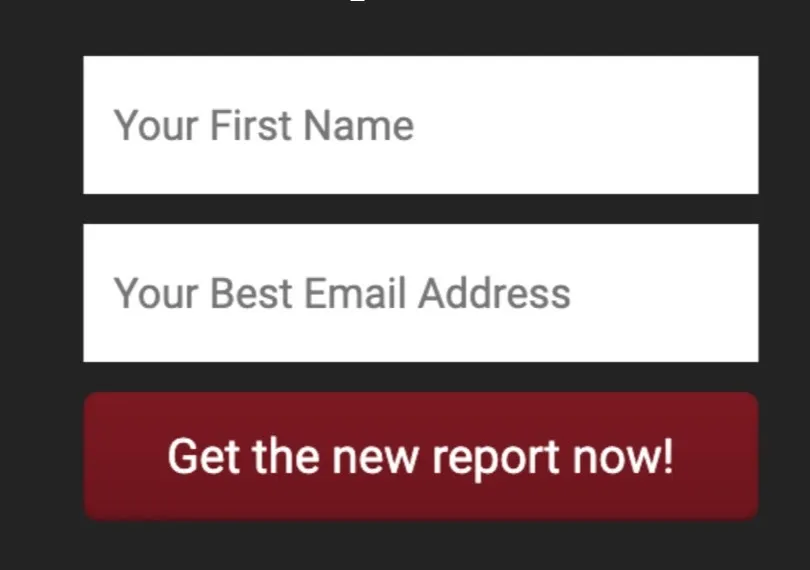
You can see John Carlton (an incredibly well-known copywriter) clearly labels the first name, the PRIMARY email address, and a call to action with a clear red button.
Here are some more examples:
- Click Here To Get Your Free Report Now!
- Click Here For Your 10% Discount Code!
- Click Here For Your Free Course On Email Autoresponders!
You need the first name to make the email more personalized and you need the PRIMARY email address of your reader. (Although it will be easier the less things they have to fill out.)
You don’t want to be seen as spam and be put into their second email addresses primarily meant for spam.
“It is always better to be in the spam box of your Primary email address than the primary email in your spam email address!”
Bond Halbert
Place Your Email Address Welcome Box On Every Page Of Your Site
You don’t know when customers will want to sign up.
You also don’t know where they are going to land first. To maximize your welcome email opt-in rate, you need to place it everywhere!
This includes your about page, contact page, home page, every article you write (maybe not the landing page for a product but you get the point!)
And that wraps up most of the tips to help people start subscribing into your content from organic results.
So now it is time to actually start crafting your first welcome email!
Here Is A Welcome Email Series Template You Can Use Immediately
- Email 1: The Welcome Email
- Email 2: Give Valuable Content
- Email 3: Your Background Story
- Email 4: Give Some More Valuable Content + Teaser
- Email 5: Valuable Content + Tease At Your Next Product
- Email 6: (Optional): Sell Your Product Or Service
- Email 7: (Optional) : Recommendation
Here is what you should accomplish in your first welcome email:
- Greet Them By Their Name (ex. Hey John!)
- Hook Them
- Outline What’s In The Email
- Introduce Yourself And Your Business
- Give Incredible Value
- Connect To Your Community
- Tease Them (Add a P.S.)
These are some rough guidelines that will help you get the most out of your first email welcome.
Greet Them By Their Name
You want this email to sound like it is coming from a friend, so a friendly way to start off an email is to say something like:
- Hey John,
- Hi John,
- What’s up John,
- Yo John, how you doin’ boi???
Make the voice something that is consistent with your brand. What you DO NOT want to do is start off cold and inhumane like:
- Dear Subscriber,
- Hello There,
- Etc…
Which is going to make that reader subconsciously (they don’t even realize it’s happening) throw it away in the spam box when they get a whiff of something salesy.
Hook Them With The First Sentence
So after you greet them, you need to hook them. Have something interesting to say. Give them a hearty welcome. Tell them what exactly you are offering in this email. Use sublines to make the emails easier to read.
Brief Description Of Who You Are And How You Can Help Them
Tell them a brief description of who you are and how you can help them.
That’s all you need in the first welcome email.
In future emails you can add more about yourself but we want to make this email as compact and powerful as possible. If you’d like you can experiment with adding:
- Fun facts about yourself
- Some more details (like how you’ve struggled with their problem)
Give Them Something Insanely Valuable That They Can’t Live Without
This is where you give away whatever you promised in the subscription box, whether it is a free consultation or an eBook.
This should be seen as valuable in the customer’s eyes.
That free eBook you gave should be something you were proud of making that has useful, applicable content and will make your customers’ lives better.
Connect Them With Your Community
If you don’t have one yet, that’s fine because you can always add this one later. But you want them to have the chance to connect with similar people with similar problems.
This is the time to connect them with your Facebook Groups and Instagram and also helps establish yourself as a credible authority.
You also want them to whitelist your email (and give extremely clear directions on how to do that) so they know your email won’t be in the spam box and prioritize it if they see value in this email.
Don’t Forget To Include The P.S.
Everyone enjoys reading the P.S. and is something old school where people would skip half of the article to glimpse at the P.S.
So this is your second chance to have a call to action for them! Here are some cool things you can do with the P.S:
- Create a Teaser For Your Next Email
- Directly Sell Them Your Services (Advanced Technique That Works For Well Known People)
- Create A Call To Action (Ex. Don’t Forget To Whitelist)
- Add A Fun Fact and make it more personable.
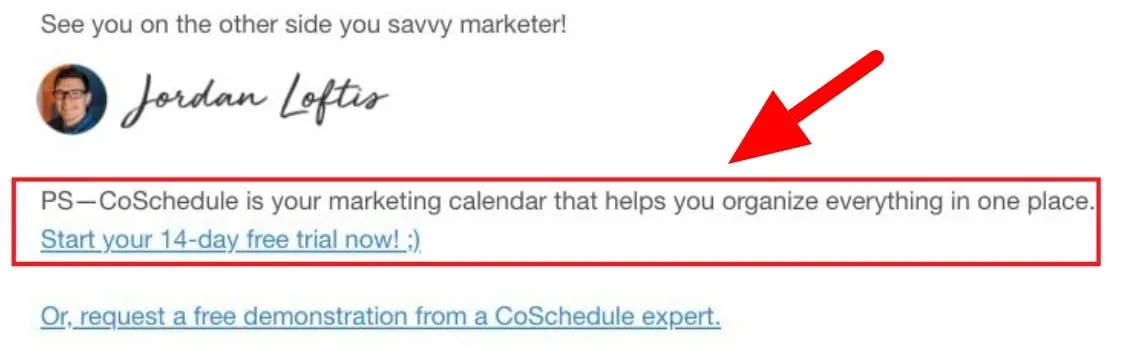
Jordan does a great job with the P.S. below…
Start having fun with all sorts of different things you can write about!
Anyway… here’s an example welcome series I wrote for a made-up brand: Kettle & Crow Coffee, a small-batch coffee roaster that sells online. The emails are signed by Sam, its (also made-up) founder.
Email 1 Example
Subject: Welcome to the Kettle & Crow family!
Preview: I’m so glad you’re here!
Hey John,
I really wanted to give you a big welcome for joining our newsletter!
Now, before I go any further, here’s the link to download your free guide, The Better Morning Brew Guide. It shows you how to make better coffee at home with the gear you already own.
>>Click Here to Download Your Free Brew Guide<<
Who Are We And Why Should You Listen To Us?
Kettle & Crow started in my garage. A few years ago, I was just someone who wanted coffee at home that didn’t taste flat and a little burnt… (like a lot of you!)
So I spent my weekends roasting, brewing and tasting batch after batch, trying to figure out why my coffee at home never tasted as good as the coffee at my favorite café.
I’ve been at this for a while, and I really understand the frustration.
The best part? I finally “cracked the code.”
And I’m really glad I get to share what I learned with you FOR FREE, so you can make a great cup at home too!
But I’ll get into that a bit later…
For now…
Here’s what you can expect from us:
Every Monday at 8:13am Pacific, we’ll send you one PRACTICAL tip you can use the very next morning.
If it’s okay with you, we might also send an email at a random time if we find something you’ll love.
Of course, you can always check our blog to see if we’ve written anything recently that might help you.
Here’s what you can do now:
Step 1: Add us to your contacts so our emails never end up in spam. Using Gmail? If this email landed in your Promotions tab, drag it over to Primary and click “Yes” when Gmail asks if you want to do the same for future emails from us.
Step 2: Come hang out with us on Facebook! Click here to join our EXCLUSIVE Kettle & Crow Home Brewers group.
It’s a place where you can surround yourself with like-minded coffee lovers who are trying to do the same thing as you: make a better cup at home. People swap recipes, ask questions and show off their setups.
Of course, if you have any questions, just hit reply and ask away! I’d be happy to answer!
Cheers,
Sam
P.S. Tomorrow I’ll send you the single most important tip for better coffee at home.
So keep an eye out for it bright and early.
WARNING: It’s so simple you’ll wonder why nobody told you sooner!
So here’s a quick analysis. Sam welcomes John to the newsletter and gives him his freebie right away. Then Sam explains who the brand is and what to expect from it.
And the email finishes with a teaser for the next email in the P.S.
Now, this is a pretty long email, which is fine, since you don’t know what John will read, and the sublines make it easy for him to jump around.
Email 2: Give Them Some Valuable Content
The second email is pretty important, because if they enjoyed your first email, this is your chance to shine and earn your spot in their inbox.
I recommend giving them an actionable, practical tip they can use IMMEDIATELY.
Something that shows you’re different from your competitors and that you really want to give value to your audience.
And you want to give them a quick win. This builds trust, because if they actually follow your advice and it works, well, that instantly makes you credible.
For example, in the email below, Sam wanted to help people who are new to brewing at home get a better cup right away with one simple habit.
That’s because most people never measure their coffee, so every cup comes out a little different!
Email 2 Example
Subject: One simple tip that makes your coffee taste better tomorrow morning
Preview: I’ve used this one every single morning for years.
Hey John,
If you read the P.S. from my last email (and maybe couldn’t catch a wink of sleep), then I bet you’re ready for this simple tip that makes your coffee taste better right away!
*Drum roll, please*
Okay… so what exactly is this tip I’ve been hyping up?
This advice is meant for the newbies, but it applies to everyone.
It’s called… Weigh Your Coffee!
Sigh… I know I just disappointed some of you coffee nerds, but this is one of the fundamentals of a great cup.
So for the beginners, here’s how it works: instead of eyeballing scoops, you weigh your coffee and your water. Start with 1 gram of coffee for every 16 grams of water, then adjust to taste.
Now why is this important?
Because scoops lie. A scoop of dark roast weighs less than the same scoop of light roast, so “two scoops” can give you a weak cup one day and a way-too-strong cup the next.
And most people come up with excuses to skip it:
- A scale feels too fussy
- My coffee is fine, I guess
- Yada yada yada…
Listen, the fastest way to better coffee isn’t fancier beans. It’s making your cup the same way every time, so you know exactly what to change.
Lots of people read up on all of it: grind sizes, water temperature, bloom times, pour patterns…
They understand THE THEORY, but they never actually change how they brew. You know what I call that? USELESS INFORMATION.
You’ll only truly learn once you weigh a few batches, taste the difference and adjust.
And don’t stress about getting it perfect on day one. Every new bag of beans takes a little adjusting.
Even pro baristas dial in their recipe again whenever they switch to a new coffee.
So if your coffee tastes a little different every morning, give the scale a shot. A basic kitchen scale works fine.
Remember: just weighing your coffee is already a win, because now you know exactly what to change tomorrow.
That’s all I wanted to share. Till next time…
Happy brewing,
Sam
P.S. If you think these tips are helpful, let me know by hitting reply and telling me how your next cup turns out. I really appreciate it. Thanks!
Email 2 Analysis
In the example above, Sam gave John a practical tip he can use tomorrow morning (since all John really wants is better coffee at home). If it works, John trusts the brand a little more.
Sam also asked for a reply, which helps build engagement and shows the brand whether this is the type of content people want to see.
Email 3: Give Your Background Story
Once you’ve shown you really know your stuff, now is the time to tell your story.
What’s the story behind your company (or yourself), and why are you qualified to solve their problem?
Email 3 Example
Subject: You only know 10% of our story…
Hey John,
I only gave you a quick glimpse of who we are in the first email, but I really wanted to tell you how Kettle & Crow actually started.
If you’ve ever wondered why the coffee you make at home never tastes like the coffee at your favorite café, we probably have a lot in common.
So let me tell you a little about myself…
For years, I drank whatever coffee was on sale at the grocery store. It was fine. Just fine. Every morning I drank a cup that tasted flat and a little burnt, and I figured that’s just what coffee at home tasted like.
Then one weekend, a friend brewed me a cup with beans that had been roasted a few days earlier, using the same cheap drip machine I had at home. It tasted like a completely different drink.
I knew right then that I wanted coffee like that every day. And honestly, I wanted everyone I knew to taste it too.
So I bought a tiny secondhand roaster and started roasting in my garage on weekends.
And this is coming from someone who had NO IDEA what they were doing. That first month was rough. I burned batch after batch, set off the smoke alarm more than once and made the whole street smell like burnt toast.
And I knew something had to change.
So I started keeping a notebook of every batch: the beans, the roast time and how it tasted. Most batches still weren’t great. But every one taught me something, and in my head, that was a win.
Over time, the batches got better. Friends started asking for bags. Then friends of friends. Then I set up a little table at the Saturday farmers market.
Now we roast every order in small batches and ship it within a couple of days, so it shows up at your door fresh.
I can help you make better coffee at home… but you have to be the one willing to try something new. Otherwise, nothing will change.
So that’s our story in a nutshell.
Here’s to your next great cup,
Sam
Email 3 Analysis
In the example above, Sam tells a hero story: someone who had the same problem as the reader (sad coffee at home), struggled with it and built the brand to fix it.
When you craft your story, you want to use specifics to make it more believable, like the smoke alarm, the notebook and the farmers market table. You want them to read the next line one after the other until they reach the end of the email (which may take some time to nail down at first.)
Email 4: Give Them Even More Value
If you are not sure what to write, just continue to keep delivering value through your emails. The more value you create for your audience, the more trust you build and the stronger the relationship you will have with them.
Email 4 Example
Subject: Grab our 30-Day Better Coffee Checklist
Hey John,
Sam here. I put together this PDF checklist for you today, and I think you’ll find it useful!
It’s called the 30-Day Better Coffee Checklist. It’s just a simple checklist to help you make coffee you love at home, every single morning.
Here it is:
Grab the “30-Day Better Coffee Checklist” Now (no opt-in required, it’s yours free)
If you actually follow it, by day 30 you’ll know exactly how you like your coffee and how to make it that way every time.
Here’s a sneak preview of what’s inside:
- The Bloom Test: how to tell in 30 seconds if your beans are still fresh (and what to do if they aren’t.)
- Why your coffee tastes bitter or sour, and the one setting that usually fixes both (hint: it’s your grind size.)
- The simple water swap that can make the same beans taste cleaner.
- And much more!
And best of all, it’s ALL FREE!
So let’s make this the year you finally love the coffee you make at home.
Talk soon,
Sam
Email 4 Analysis
Sam helped John here by giving him an unexpected checklist that makes his mornings a little better. No upsells, no anything.
Just building up trust and value.
Email 5: Give Them Even More Value + (Optional: Preview Sale)
You could have stopped at Email 3 or 4, but I feel you can never go wrong if you keep providing more value for the subscribers who actually stick around to read your emails.
That means you know that this person finds your content valuable and is the type of audience you are going for.
Subject: The Overlooked Reason Your Coffee Goes Stale So Fast
Hey John,
I hope you’ve been using the tips I’ve shared and enjoying some really good cups of coffee.
I wanted to share some vital advice that gets overlooked all the time.
Finding beans you love is hard, but I’d argue it’s even harder keeping them tasting great all the way to the last scoop.
That’s because coffee starts losing flavor soon after it’s roasted, and it fades even faster once the bag is open. Suddenly the bag that tasted amazing last week tastes flat and papery.
And that’s frustrating, because you paid for good beans.
But you want that bag to taste great until the very last cup, and I have just the simple tip for you.
And that is…
Store Your Beans The Right Way!
What, you wanted a more exciting tip? “Sam, I already know this, so give me something I don’t actually know!”
Tsk tsk. The reason I’m bringing it up is that it’s one of the most overlooked problems with coffee at home.
Here, let me give you an example you’ll recognize.
You open a fresh bag, roll the top down and leave it on the counter next to the stove. It sits in the afternoon sun, and the steam from your kettle hits it every morning.
Two weeks later, you’re wondering why the same beans suddenly taste dull.
And pay attention here, young chap: heat, light, air and moisture are what make coffee go stale.
So the key point is:
Keep your beans in an airtight container, somewhere cool and dark, and grind only what you need right before you brew. And skip the fridge, which adds moisture and picks up smells from everything else in there.
That’s how one small habit can put a dent in a really good bag of coffee.
Hope you found that useful.
Cheers,
Sam
P.S. Our Harvest Blend, the one we only roast once a year, is almost ready. Subscribers get first dibs, and I’ll fill you in on all the details in my next email.
Email 5 Analysis
In this example, Sam shares one more useful tip that John can use with the coffee he already has.
If you have a product you are already offering, then you can segue into previewing a sale for your product, like the Harvest Blend teaser in the P.S.
This is completely optional and emails 1-4 would be enough before they see your broadcast emails.
But here is an example of how I would lead the welcome email series into a sales pitch.
Email 6: Selling Your Product Or Service (Optional)
Now if you have something to sell, this is one way to segue from a welcome series to a sales email sequence (in this case, it’s the brand’s once-a-year Harvest Blend.)
Subject Line: Our Harvest Blend Is Here… Grab Your Bag Before It’s Gone!
Hey John,
The Harvest Blend is finally here! We roast it once a year from a single harvest, and it’s the coffee I look forward to most.
Here’s a small glimpse of what you get:
- Notes of dark chocolate, cherry and brown sugar (great black or with a splash of milk)
- Roasted to order in small batches and shipped within two days of roasting, so it shows up fresh
- A printed brew card with the exact recipe we use for pour-over, drip and French press
- …And a little surprise in every box!
Hurry, because we only roast this blend once a year. When this batch is gone, it’s gone until next year. (I know. I’m sad about it too.)
Subscribers get first dibs for the next 48 hours before we open it up to everyone else, so grab your bag NOW.
Cheers,
Sam
P.S. The Harvest Blend is first come, first served, so if you want a bag this year, I’d grab yours now while we still have some!
Email 6 Analysis
Now it’s time to make an offer, because at this point you have built enough trust with them.
And keep the urgency real. If you say it’s a once-a-year batch, it had better be one.
Email 7 Follow Up + Example (Optional)
You can also add this at the end of your welcome email sequence just to see what your audience really wants from you.
Subject: Can I ask you a quick favor?
Hey John,
Boy, what a week. Thank you to everyone who grabbed a bag of the Harvest Blend. Our little roaster hasn’t worked that hard all year.
Some of you have been brewing for years, and some of you just bought your first scale. I loved hearing from all of you.
But anyway, I want to know what you think of these emails. Hit reply and tell me what you want more of: brewing tips, recipes or the stories behind where our beans come from. I’ll use your answers to plan future emails.
Thanks,
Sam
P.S. A few people who missed the Harvest Blend asked if we could make something like it all year round. I’m still thinking about it, but I’ll let you know what we decide.
Email 7 Analysis
Sam asks readers what they want more of, so future emails give them exactly that. And the P.S. teases a possible new product for anyone who missed the Harvest Blend.
Now How Do I Set This Up?
I used MailChimp when I started out, and later switched to ConvertKit (now called Kit).
But basically you would use an email service provider and once you finished crafting your text, you just copy and paste it and it will run on autopilot.
Note: Be sure to test out different variations on headlines and copy to see which one has a higher open rate!
Frequently Asked Questions
What Are Some Other Resources You Can Check Out To Help Craft My Welcome Series?
You can also check out some awesome guides at Meera Kothand and Raelyn Tan who also teach you exactly on what you need to know to craft a killer welcome email series.
Do I have to follow this exact guideline?
No, you don’t! I created a sample welcome series template to help guide you through the process of how to make one. You can rearrange it, delete stuff, add new stuff to it.
Of course don’t copy my emails verbatim, but you can use it to inspire yourself on what you should write.
Won’t my broadcast emails interfere with my welcome series?
Not if you set it up correctly!
Make sure that your broadcast emails are only sent to people who have finished your welcome email series.
This is because you don’t want to ruin the experience of this series you put a lot of effort into making.
Do you need an email list for this to work?
You can set it up before you have an email list so you have some sort of automation going on when people sign up for your newsletter.
Of course you won’t see any open rates if there is no one on your newsletter!
How many emails should I have?
3 to 5 emails is a good place to start and you can always add or subtract in the future when you can find out which is the best combo for you.
What should I have in my emails?
It mainly depends on the type of website you have (store, blog, nonprofit, etc) and the goal for your emails.
Each email should be customized for your goal and for your audience.
Stuck on yours? Send me your question and tell me what kind of business it’s for.
How far apart should my emails be spaced?
This is something to test, but you would be safe every 2-4 days.
What Should I Do Now?
Start crafting your first welcome email series and tell me how it goes!
If you found this post useful, send me a message.
Filed under Email and SMS marketing